
New sources of materials for batteries from cereal processing and other by-products
Could industrial and cereal processing side streams become tomorrow’s battery materials? A seminar in Kuopio brought together promising research on silicon from barley husks, material recovery and the practical challenges of turning by-products into new battery materials. Explore the findings and opportunities for a more circular battery industry.

There is an increasingly active search for new raw materials from industrial and cereal processing side streams to meet the needs of the battery industry. In October, researchers presented their findings and discussed the potential for utilising by-products at the ‘Industrial Side Streams as a Source for New Battery Materials’ seminar held in Kuopio.
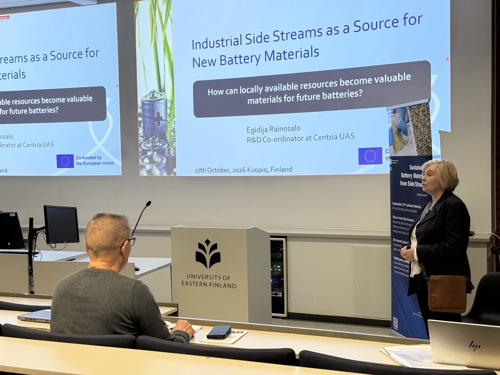
In her opening presentation, Pia Vilenius, Chief Executive of the Finnish Battery Industry Association, examined the current state and future prospects of the Finnish battery industry. Her presentation highlighted the sector’s changing operating environment, growing demand for batteries, and the update to Finland’s battery strategy for 2026–2030. The strategy’s priorities include battery materials and their processing, the circular economy, electric work machines and energy storage, as well as Arctic and dual-use solutions.
Professor Vesa-Pekka Lehto from the University of Eastern Finland presented the use of silicon contained in barley husks as an anode material for lithium-ion batteries. Porous silicon is produced from barley husk ash using a magnesium-thermal reduction process. According to the research findings, combining the silicon material with carbon nanotubes improved its performance during rapid charging and discharging. The results demonstrate that materials with promising properties for the battery industry can be developed from agricultural side streams.
Professor Ulla Lassi from the University of Oulu discussed the recovery of lithium and other valuable materials from industrial by-products and used batteries. One of the research findings presented concerned the recovery of lithium from residual material from the Bayer process in the aluminium industry. In the study, up to 99.6 per cent of the lithium was recovered. The black mass produced during the recycling of lithium-ion batteries contains valuable raw materials, such as lithium, nickel, cobalt, manganese and graphite, which, after recovery and purification, can be utilised in the manufacture of new battery materials.
Seppo Leinonen from the Geological Survey of Finland discussed the recovery of graphite from industrial by-products. Graphite is a key battery material, and researching alternative sources of raw materials for it promotes the circular economy for materials.
Alongside the research findings, the seminar also emphasised the practical applicability of the materials. In his presentation, Juho Heiska from SEAMK pointed out that promising laboratory results alone do not guarantee material’s suitability for the battery industry. The performance of materials must be assessed in actual battery cells, and they must also meet the requirements of industrial production in terms of, for example, quality, durability and consistency.
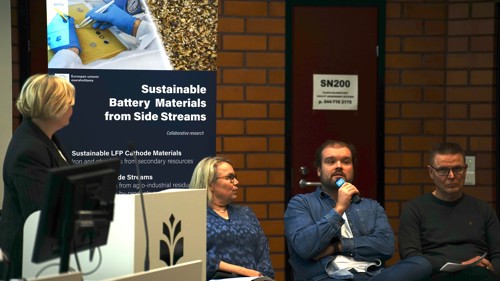
In the panel discussion that followed the presentations, experts together with Mikko Ahokas from Macon Ltd. and Pia Vilenius from the Finnish Battery Industry Association discussed the future prospects of the sector and the opportunities that new battery materials present for companies.
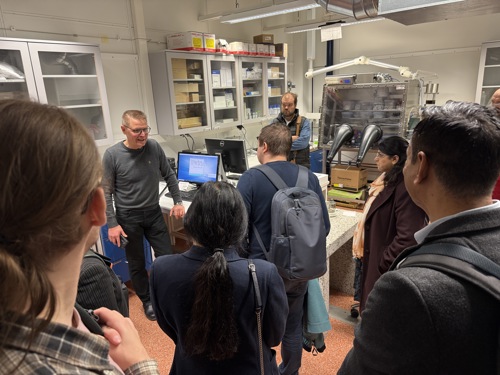
To round off the day, participants were also given the opportunity to visit the University of Eastern Finland’s laboratories for fine particle and aerosol technology and battery testing.
The BATTSi and EKOAKKU projects, coordinated by Centria University of Applied Sciences, are developing new solutions for utilising industrial by-products in the manufacture of battery materials. The aim is to reduce the need for non-renewable raw materials, promote the circular economy and low-carbon practices, and strengthen research and business collaboration in the battery sector. The BATTSi project is funded by the EU’s Interreg Northern Periphery and Arctic programme, and the EKOAKKU project by the European Regional Development Fund and the Regional Council of Central Ostrobothnia.


