
Unlocking the Potential of Wool: Bio-Based Additives for the Next Generation of 3D Printing
In many countries across the Northern Periphery, sheep wool is produced in large quantities and, due to low demand, it is often a lowvalue residual by-product.

In many countries across the Northern Periphery, sheep wool is produced in large quantities and, due to low demand, it is often a lowvalue residual by-product. Yet it may actually be a hidden resource that can serve as alternative to fossil-based counterparts by shaping the future of sustainable 3D printing. This idea lies at the heart of the BIO-2-PRINT interregional collaboration, which involves partners in Finland, Ireland, and Sweden.
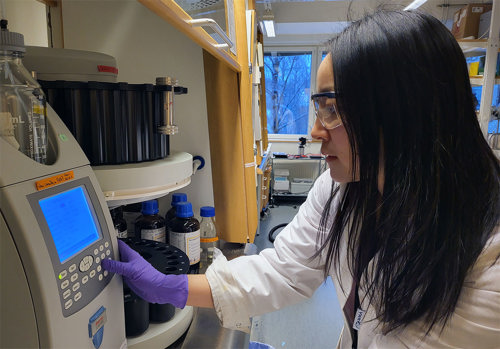
Using advanced extraction techniques and chemical analyses, the Swedish team from Umeå University is investigating the untapped potential of wool waste and other agricultural or industrial side streams. Wool consists of fibers that can potentially serve as natural reinforcement in 3D-printed materials. It also contains relatively high levels of extractives that could function as biobased additives in 3D-printing. Additives such as plasticizers, antioxidants, and flame-retardant substances are essential in high-quality additive manufacturing. Wool-derived extractives may offer a sustainable alternative to fossil-based counterparts. By comparing the fiber content, extractive profiles, and mineral composition across different wool qualities, the researchers are searching for new bio-based composites that one day could replace petroleum-derived materials.
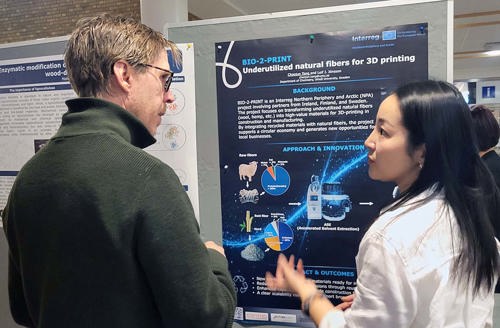
The Swedish team shared its initial findings at a Bio4Energy meeting in Umeå, where participants from academia, research institutes, industry, and NGOs gathered to discuss the possibilities of using local bio-based resources in new ways. The poster of the BIO-2-PRINT project was awarded first prize at the event, a clear sign of the growing interest in finding practical, sustainable uses for materials that are currently undervalued. The work was later presented to an even broader audience through an online event hosted by the BIO-2-PRINT project, contributing to ongoing discussions about circular value chains and innovative applications of natural fibers.
Authors: Leif Jönsson and Jenny Lundqvist from Umeå University
Read more


