
New article: “Dystopian Finland in 2055” – Learning about Cybersecurity through Cyberpunk and Role-Playing
Finland 2055 brought cybersecurity learning to life through an immersive cyberpunk role-playing game in Kuopio.

You can also read the article in Finnish.
28 February 2055, Kuopio.
Our local resistance movement has arrived at the offices of the National Land Survey, now controlled by NYX. Our leader, Harald, has recruited just over a dozen volunteers to take part in this challenging but important mission: we must replace the share certificate forged by NYX with the original document, allowing Harald to reclaim what rightfully belongs to him.
The mission will certainly not be easy, as the National Land Survey’s security measures are strong. Fortunately, our group always finds a way around such obstacles without leaving a trace. Under the leadership of Harald and our cell leader, we are beginning an operation that will mark the start of NYX’s downfall!
-Breeze
The story takes place in a fictional, dystopian Finland in 2055, where the ruling and malevolent artificial intelligence NYX has divided Finland’s largest cities into separate “city-states”. As one might expect, not everyone is willing to live under the rule of an AI that oppresses people. A resistance movement is rising against NYX!
Developed by LEA, the Legendary Endeavours Association, Finland 2055 combines learning and training related to cyber and information security with role-playing set in a cyberpunk world. The game includes online missions as well as live-action role-playing events. Finland 2055 is a nationwide game that was launched at the Disobey 2026 hacker culture event and will conclude at the same event in 2027.
LEA does not run each “city-state” alone. Every participating city has its own group of volunteer enthusiasts creating local stories and game events, which have been in development since 2025. In Kuopio, the volunteers represent four local associations and one project: Kuopion Roolipelaajat (Kuopio Role Players), KuoSec, Hacklab Kuopio, IGDA Kuopio Hub and the InnoGS project.
The InnoGS project was particularly eager to become involved in Finland 2055 because it is an excellent example of how gamification-related activities can bring different associations together and help people learn important skills.
The collaboration between role-players, the cybersecurity community, DIY makers, game developers and the project has worked extremely well. One demonstration of this was the first event in Kuopio’s three-part Finland 2055 live-action role-playing series, held at Kulttuuriareena 44 (Culture Arena 44) on 28 February 2026. It was also the first live-action role-playing event in the nationwide Finland 2055 game.
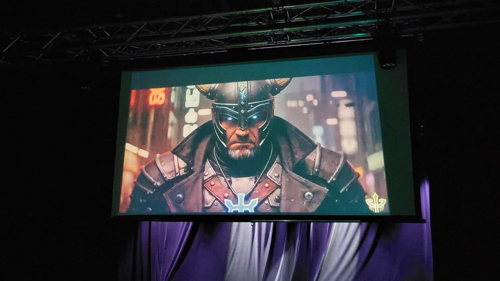
Harald, the leader of the Kuopio resistance movement, gave orders to the players through AI-generated videos.
Good Planning and Skilled Contributors Are Key to a Successful Implementation
Once the background story of the “City-State of Kuopio” was ready, the group began developing and preparing the first game event. The aim was to create an immersive experience on a zero budget for players who might have had little or no previous experience of role-playing.
For both the planning and marketing of the event, it was therefore easier to describe it as an “escape room-style experience” in which each participant would also play a character suited to the theme. The players had to create their own cyberpunk-inspired characters and select a character class. This gave them in-game abilities that they might not necessarily possess in real life. The organisers also needed to create characters, as several non-player characters were required to guide the participants during the game.
Thanks to an earlier visit to the venue and careful advance planning, the main hall of Kulttuuriareena 44 was transformed into the “National Land Survey office of 2055” within a few hours before the game began. In addition to various props, the set used lights, videos and sound effects controlled during the game by a technical team operating from behind the scenes.
Confidence in the advance planning and the skills of the team was strong, but so was the nervous excitement, as there had been no opportunity to test the complete game beforehand. The players therefore experienced the finished game for the first time alongside the organisers.
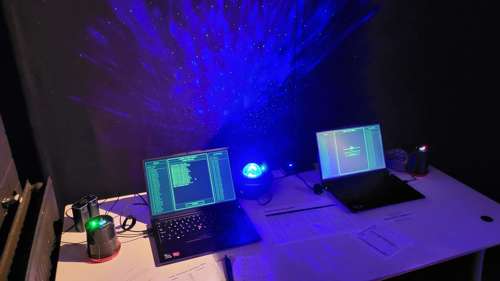
The sets and tasks were created using the organisers’ own and borrowed equipment, together with the skills available within the team.
A Time Jump to 2055
Before the game began, the players were introduced to the rules, safety procedures and everything else they needed to make the experience enjoyable and, above all, safe for everyone. Although dystopian cyberpunk can be an extremely dark genre, the intention was not to create an overly distressing experience. Instead, the organisers wanted to include just the right amount of low-key tension.
Eventually, the players were ready to leave the present day behind and travel with the organisers to “the year 2055”.
The game began in the staff break room of the “National Land Survey office”, where the members of the resistance received instructions and orders from an organiser playing their cell leader. Their mission was to replace the forged share certificate stored inside the building with the original document belonging to Harald. However, strong security measures stood in their way.
Fortunately, a resistance sympathiser working inside the National Land Survey had prepared the mission for them in advance. In a video message, Harald—an AI-generated character created as the leader of the Kuopio resistance—announced that the resistance members had only two hours to complete the mission and escape from the building.
The action began immediately in the break room, where the players had to locate hidden security cameras and disable them by covering their lenses with tape. This opened the way into the “National Land Survey offices”, located in the main hall of Kulttuuriareena 44.
The remaining challenges took place there and included covering more cameras, searching for NFC tags, QR codes and clues, and solving puzzles familiar from escape rooms. Each completed challenge unlocked another one, until the players finally reached the building’s vault.
Inside the vault, they found a safe and a briefcase containing the two share certificates. The documents had to be exchanged before the resistance could consider its mission complete.
Even the flashing red alarms and imaginary drone patrols that were triggered from time to time did not frighten the resistance members. They successfully completed their mission within the two-hour time limit. Harald then appeared on a screen to congratulate them and order them to escape, triggering the alarm one final time. Once everyone had made it safely out of the building, the game was officially over.
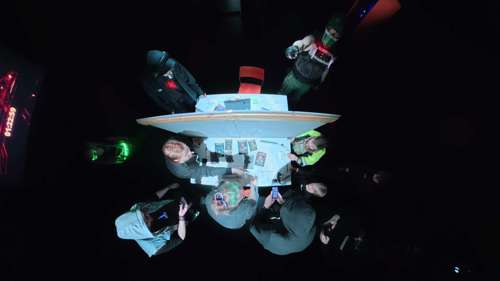
The players solving escape room-style puzzles against the clock visible in the background.
Post-Mission Debrief
Despite the organisers’ nervousness, the game went very smoothly, and the nine satisfied players agreed. They particularly praised the atmosphere, the quality of the implementation and how easy it had been to join the event.
Many were surprised that such a high-quality experience had been created by ten volunteers within a tight schedule. Some of the players stayed after the game to discuss the tasks, solutions and practical implementation with the organisers. This was a clear sign that the experience had sparked genuine interest.
The players may not have noticed—and they were not supposed to—but the organisers needed careful judgement throughout the game. They had to ensure that every player had something to do and that the group did not spend too much time solving any single challenge. When necessary, the organisers’ characters improvised ways to make the challenges easier so that the players could continue progressing. This approach had been agreed upon by the organisers in advance.
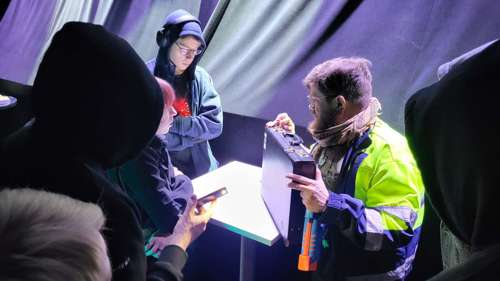
The players fully committed to the game and dressed as their characters.
Why Practise in the “Future” for the Present Day?
The challenges and puzzles were designed to relate in some way to cyber and information security. For example, the players searched for solutions by rummaging through printed documents containing fictional email conversations.
This simple exercise can make people realise how easily someone could access another person’s conversations if information security were neglected in the same way as it had been by the fictional employees of the National Land Survey. Skills learned through enjoyable, gamified challenges and problem-solving can often be absorbed more effectively than the same content presented only through a lecture, written text or set of instructions.
Tuuli Siiskonen, Chair of LEA, explains that Finland 2055 was created because cybersecurity is a civic skill that extends beyond information technology into every area of life, including culture. To safeguard the stability and security of Finnish society, it is important to prevent activities and communities from becoming isolated in separate silos.
In Kuopio, Finland 2055 has already succeeded in breaking down some of these silos by bringing as many as four associations together to organise the local game events. The participating communities have also discussed how this collaboration could create promising opportunities for other joint activities in the future.
I agree with Tuuli’s view of cyber and information security as civic skills. Gamified methods offer an excellent and enjoyable way to teach these skills to ordinary citizens, particularly when gamified “training” can bring together the knowledge and abilities of both enthusiasts and professionals from many different fields.
I also hope that the threats portrayed in the world of Finland 2055 never become reality and remain nothing more than entertaining and educational fiction—an enjoyable escape from everyday life. After all, by 2055 I will already be very close to retirement age, and I would prefer to spend my retirement peacefully rather than having to join a resistance movement and fight against an evil artificial intelligence!
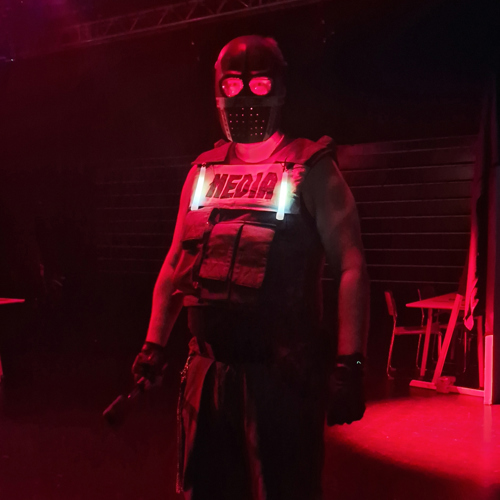
The author as his character, Breeze. As a representative of the media, Breeze documents the activities of the resistance and publishes news opposing NYX. Photo Tarja Tapaninen.
You can read more on the Finland 2055 website.
Authors
Kalle Sievänen, RDI-specialist, InnoGS -project, Sustainable Societies’ research field, Savonia University of Applied Sciences.
AI has been used in writing the article.

See more


