
Transforming underutilised biomass
We strengthen the capacity to adopt bio‑based and recyclable composites in real‑world applications.

What we do?
The project builds on the results of previous initiatives and brings together expertise in natural fibres, biopolymers, and additive manufacturing. Its aim is to develop practical tools for circular design.
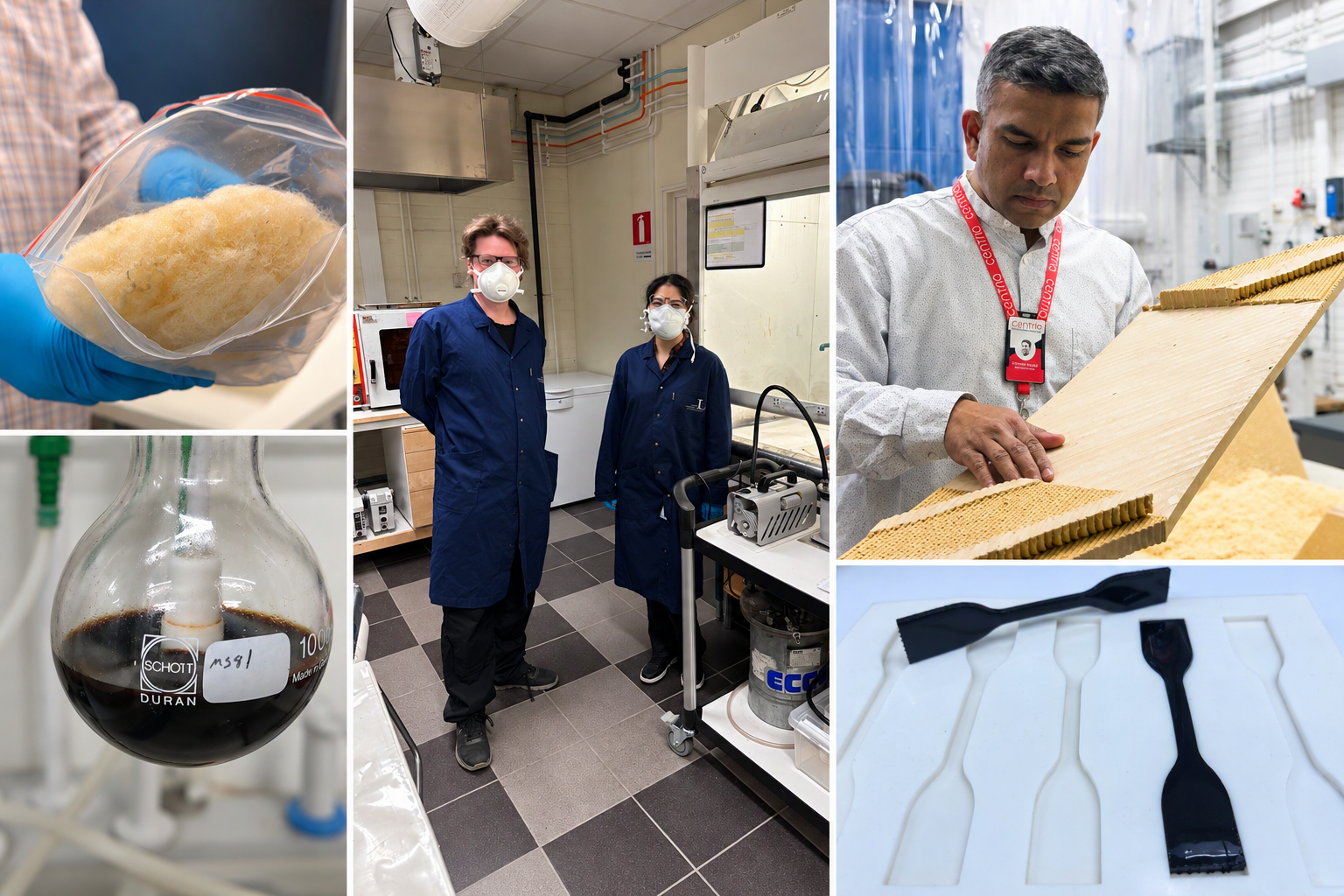
The W2W-Composites project is progressing towards developing and demonstrating more sustainable composite material solutions. We are working on two pilot activities focusing on bio-based protective coatings for 3D-printed composites and wool-fibre-reinforced composite materials. Alongside these technical developments, the project is strengthening its stakeholder network to support knowledge exchange and the wider adoption of sustainable composite technologies.
Advancing the development of 3D-printed composites and protective coatings
One of the project’s key activities focuses on improving the surface properties and durability of large-scale 3D-printed wood-fibre/polypropylene composites. These materials offer opportunities for applications such as moulds and structural components, but their surface roughness and moisture sensitivity present challenges.
Centria University of Applied Sciences has manufactured and supplied 3D-printed composite samples with both as-printed and CNC-machined surfaces to the University of Oulu for coating development. Initial evaluations of bio-based coating formulations originating from the SUSBICO project have shown promising surface wetting behaviour. The University of Oulu has also initiated UV-curing trials to investigate coating technologies that could be applied without exposing the printed structures to high curing temperatures.
Developing Wool-Fibre-Reinforced Composite Materials
The second demonstration activity explores the potential of wool fibres as reinforcement in composite materials. Building on the BIO-2-PRINT project’s activities, Luleå University of Technology (LTU) has successfully produced aligned wool-fibre preforms through carding, including a second preform prepared for composite manufacturing trials.
The project partners are now planning the production of wool-fibre-reinforced composite panels using vacuum infusion. Two resin systems will be investigated: a conventional polyester resin and a modified formulation incorporating a bio-based styrene replacement. These trials will provide valuable insights into the manufacturing possibilities and performance of wool-based composites, while exploring opportunities to increase the use of renewable raw materials.
Strengthening Stakeholder Engagement and Knowledge Sharing
Beyond the technical pilot activities, we are working to establish a network connecting research organizations, companies, municipalities and other relevant stakeholders. Future Cast CLG is coordinating stakeholder mapping activities, with partners contributing regional contacts and expertise. The information collected will support the development of stakeholder maps, visual communication materials and future engagement activities.
Looking ahead, the consortium is planning an online stakeholder workshop in January 2027, bringing together relevant organizations to discuss project developments, sustainable composite applications, commercialization opportunities and potential pathways for wider implementation.
The project is also exploring opportunities to share its progress at the Interreg Northern Periphery and Arctic event in Copenhagen on 9 December 2026. Through collaboration across partner organizations and related research initiatives, W2W-Composites aims to bridge the gap between material development and practical applications, contributing to a more circular and sustainable composite materials sector.